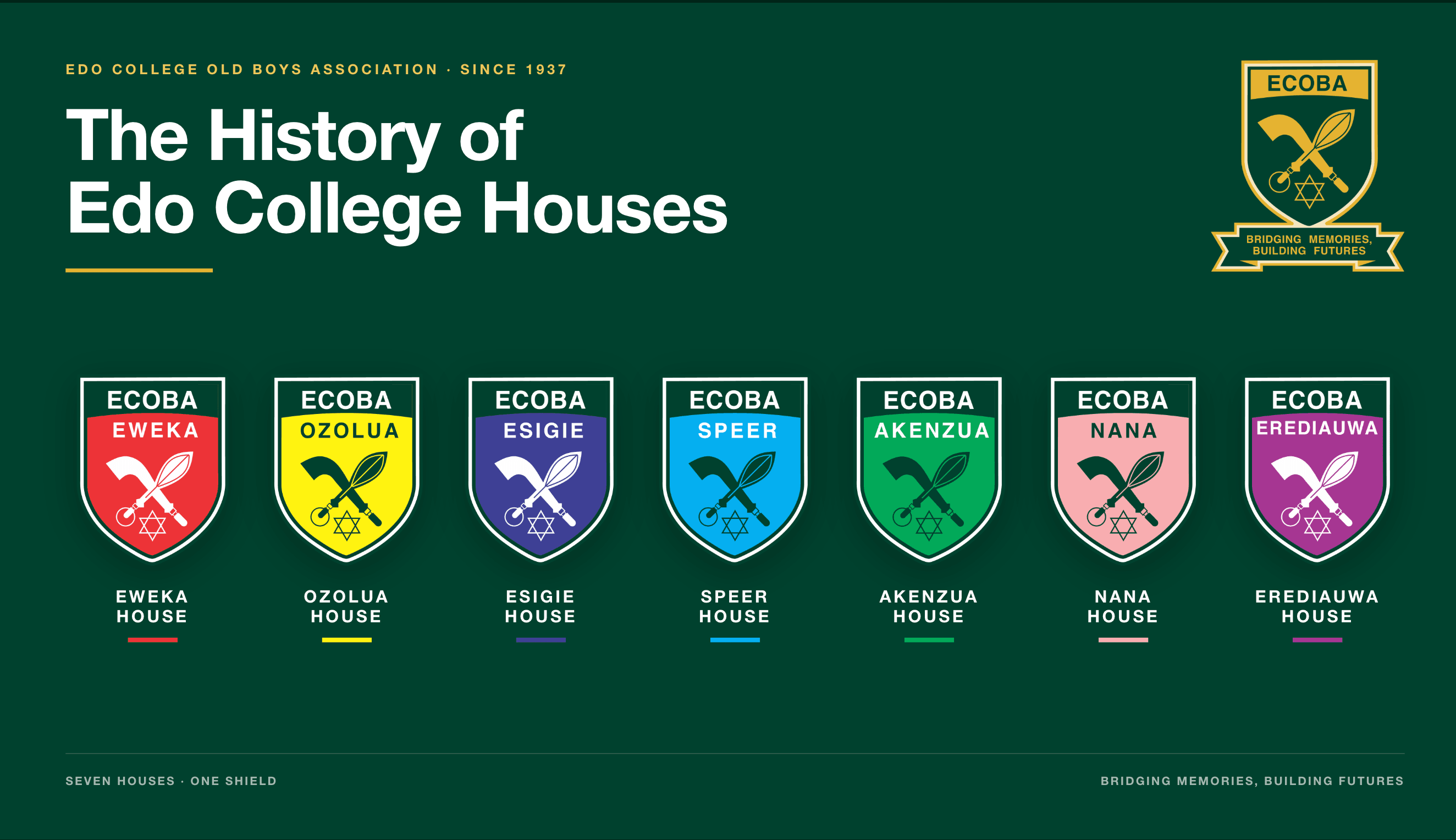
The history of Edo College is closely intertwined with the development of its boarding houses. From the establishment of Eweka House in the 1930s to the more recent Erediauwa House, each house reflects a particular period in the growth of the College and the traditions that have shaped generations of students.
The following account traces the origins and development of the houses of Edo College, drawing primarily from The History of Edo College, as well as personal recollections and knowledge.
1. Eweka House
On 5 April 1937, Edo College, with a total enrolment of 76 students—18 boarders and 58 day boys—moved into its new buildings.
Eweka House was the College's first boarding house. It was named after Oba Eweka II, who was deeply interested in and supportive of the establishment of Edo College.
The creation of Eweka House marked the beginning of the College's boarding tradition and laid the foundation for what would eventually become a well-developed house system.
2. Esigie House and 3. Ozolua House
Esigie House and Ozolua House appear to have been created simultaneously in January 1938, initially as part of the College's growing emphasis on sports and inter-house competition.
According to The History of Edo College:
"The early division of the college into 'Houses' at the close of January 1938 crystallized the high regard the college had for sports and the encouragement sporting activities got."
At this stage, the number of boarders was still relatively small. Eweka was the only house with boarders, and it competed in inter-house activities alongside day students.
The housemasters at the time were Mr Edokpayi for Eweka House, Mr Molokwu for Esigie House, and Mr Diagbonya for Ozolua House.
The history of the College further records that by 1 April 1947, Edo College had become completely government-owned and had been approved for a full Grammar School course. By this period, Esigie and Ozolua had also been opened as boarding houses, and the College had become wholly residential, with a well-established house tradition.
This suggests an important distinction in the history of the two houses: while Esigie and Ozolua appear to have been established as house identities for competitive purposes in 1938, they became physical boarding houses by 1947.
4. Speer House
The College's fourth boarding house, Speer House, was inaugurated in April 1949 to accommodate 38 boys.
The building was completed in a remarkably short period of just two months, during February and March 1949.
Speer House was named after J. G. Speer, a Senior Education Officer in Benin. Mr Speer also donated the Athletics Cup to Edo College, further reflecting the important role that sporting activities played in the life and traditions of the institution.
5. Akenzua House
Akenzua House commenced operation in 1964, with Mr Jean de Grandsaigne serving as its first housemaster. Students affectionately nicknamed him "Quest que c'est."
Mr de Grandsaigne was a French teacher who, remarkably, learned his English while at Edo College. He later taught the compiler's class for three years before leaving the College.
The establishment of Akenzua House represented another stage in the expansion of Edo College's boarding facilities as student numbers continued to grow.
6. Nana House
Nana House, originally known simply as New House, was inaugurated in 1968 in response to a shortage of boarding accommodation at the College.
Its establishment followed a policy requiring students whose parents or guardians lived in Benin City to provide a double-decker bed if they wished to retain their places in the boarding houses.
Nana House was a wooden prefabricated structure produced by ATP, Sapele, at the time. Its creation was another practical response to the increasing demand for boarding places and the continuing expansion of the College.
Reference: Personal experience.
7. Erediauwa House
Erediauwa House is unique among the Edo College houses because it did not exist at the former Iyaro site.
The house was built with funds donated by an Old Boy of the College who wished to remain anonymous. It was officially named Erediauwa House in December 2017, during the celebration of Edo College's 80th anniversary.
The name was agreed upon by ECOBA Worldwide, authorized by the Ministry of Education, and approved by the Palace.
The choice of the name was a fitting tribute to Oba Erediauwa, a distinguished Old Boy of Edo College and a Patron of ECOBA. His name thus became permanently associated with the institution and its continuing tradition.
A Tradition That Continues
The evolution of the Edo College house system reflects the wider history of the College itself. What began with a single boarding house, Eweka, in 1937 gradually developed into a system of houses that supported not only residential life but also the College's strong tradition of sports, competition, camaraderie and school identity.
From Eweka, Esigie and Ozolua in the formative years, through Speer, Akenzua and Nana, and eventually Erediauwa, each house represents a chapter in the continuing story of Edo College.
Beyond the buildings themselves, the houses have provided generations of students with a sense of belonging and identity. They have been the setting for friendships, rivalries, sporting contests, discipline, leadership and countless memories that have endured long after students left the College.
The history of the houses is therefore more than a record of when buildings were established. It is also a history of the growth of Edo College and of the traditions that have helped make the institution what it is today.